How to Choose the Right Beginner Guitar Book PDF: A Buying Guide
The best beginner guitar book PDFs combine structured lessons, clear diagrams, and practical exercises you can work through at your own pace, without the recurring cost of in-person lessons or subscription apps. If you’re starting from scratch, you want a resource that explains chord shapes, strumming patterns, and basic music theory in plain language, with plenty of visual guides and song examples that keep practice sessions fun rather than frustrating.
I’ve been teaching guitar for years, and I’ve seen countless students walk in with printouts from all over the internet, some brilliant and some barely legible. The difference between a PDF that gathers dust and one that gets dog-eared and coffee-stained comes down to three things: clarity, progression, and real-world application. A good beginner book doesn’t just dump information on you. It builds skills step by step, explains why you’re learning each technique, and gives you songs you actually want to play.
The challenge is that “beginner guitar book PDF” covers everything from single-page chord charts to 300-page comprehensive courses. Some are free downloads that skip crucial fundamentals, while others are professionally designed programs that rival what you’d get in Joe Grushecky lessons or similar structured courses. Your job is figuring out which type matches your learning style, schedule, and goals. This guide breaks down exactly what separates a genuinely helpful resource from a time-waster, so you can choose with confidence and start making music instead of second-guessing your download.
What Makes a Great Beginner Guitar Book PDF

A great beginner guitar book PDF isn’t just about having the right information, it’s about presenting that information in a way that actually helps you learn. I’ve seen students download thick, impressive-looking PDFs only to abandon them within days because the material felt overwhelming or disconnected from their goals. The difference between a PDF that sits unused on your hard drive and one that becomes your trusted learning companion comes down to a few essential characteristics.
First, effective beginner PDFs are built around progressive learning. They start where you actually are (not where the author assumes you should be) and move forward in digestible steps. Each new concept should connect clearly to what you just learned, creating a logical path rather than jumping randomly between topics. When I work with students who’ve struggled with poorly designed materials, they often describe feeling lost because the book introduced barre chords before they’d mastered basic open chords, or threw music theory at them before they could comfortably change between two positions.
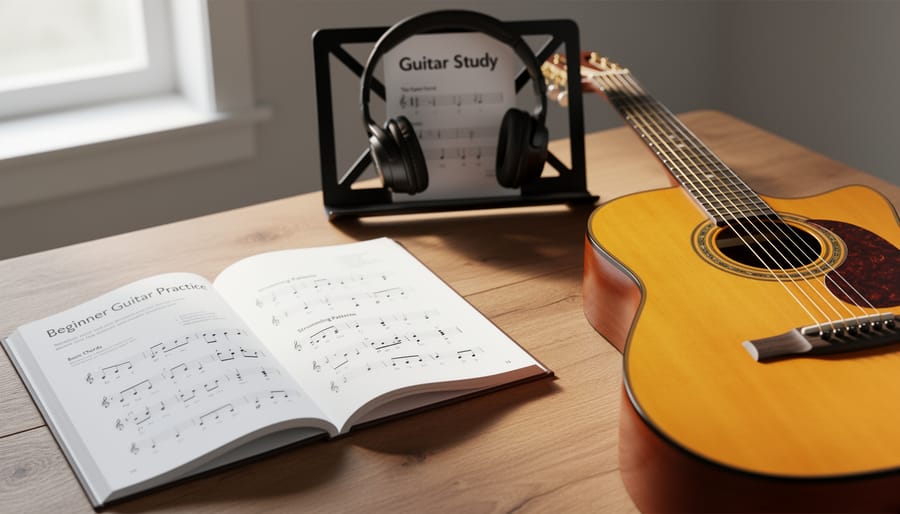
Second, clarity matters tremendously in PDF format. Since you’re viewing this on a screen or printing pages, the chord diagrams need to be crisp and large enough to read easily. Finger placement photos should show exactly where your hand goes, not artistic shots that look nice but hide the important details. Tablature should be formatted so the numbers don’t blur together. I’ve watched students squint at poorly scanned diagrams, trying to figure out whether that’s a “3” or an “8” on the fret marker.
Finally, the best beginner PDFs balance instruction with application. Pure theory without songs to play gets boring fast. But song collections without explanations of technique leave you copying shapes without understanding what you’re doing. A quality PDF gives you both the “what” and the “why,” then lets you practice through music you actually want to play.
Key Factors to Consider When Choosing Your Guitar PDF
Learning Progression and Structure
A well-structured beginner guitar PDF should take you from open strings to full songs through clear, logical stages. Look for books that introduce one concept at a time, first single notes, then basic chords, then strumming patterns, then combining them, rather than dumping everything on you at once. The best resources mark your progress with milestones you can celebrate, like “Week 3: Play your first complete song” or “Lesson 10: Master the chord change between G and C.”
I’ve seen students waste months with disorganized PDFs that jumped randomly between techniques. One student came to me frustrated after using a book that taught barre chords on page 12, before he’d even mastered open chords. He felt defeated, convinced he lacked talent. The problem wasn’t him, it was the material’s sequencing. When he switched to a proper step-by-step method that built skills incrementally, his confidence returned within weeks.
Check the table of contents carefully. Does each chapter build on the previous one? Are there regular review sections? Good progression feels challenging but achievable, not overwhelming.
Visual Clarity and Diagrams

When you’re staring at a chord diagram on your phone at 2 AM trying to figure out where your fingers go, you quickly realize that visual clarity isn’t just nice to have, it’s everything.
A quality beginner guitar PDF needs crisp, well-labeled chord diagrams with finger numbers clearly marked. I’ve watched students squint at blurry tablature, guessing whether that’s a 3 or an 8 on the fret line, and it kills their momentum. The diagrams should show exactly which finger goes where, with fingertip photos from multiple angles when introducing new techniques.
Screen size matters more than most people think. What looks perfectly readable on your laptop might become unworkable on a phone screen. Before committing, zoom in on a sample page to your typical viewing size, if you’re constantly pinching and scrolling just to see one chord, that PDF will frustrate you daily.
Print quality is equally crucial if you prefer physical copies. Low-resolution images turn into muddy messes on paper. Look for PDFs with vector graphics or high-DPI images that survive printing. Your practice sessions should focus on playing guitar, not deciphering unclear diagrams.
Practice Exercises and Song Selection
The best beginner guitar PDFs strike a careful balance between skill-building exercises and songs you actually want to play. I’ve watched too many students burn out on books that were nothing but finger drills and scale patterns, they abandoned the guitar before ever playing a complete song. On the flip side, jumping straight into complex songs without foundational exercises leaves gaps in your technique that haunt you later.
Look for PDFs that weave exercises and songs together strategically. The ideal resource introduces a new technique through a focused exercise, then immediately applies it in a simple song. This keeps practice sessions engaging while building muscle memory efficiently. Variety matters enormously: if every song sounds like a folk ballad from the 1960s and you’re into rock, your motivation will crater fast. The songs should span different styles and tempos, giving you diverse practice contexts.
Familiar songs, even simplified versions, create powerful motivation. There’s nothing quite like recognizing the opening riff you’re learning. Just make sure the PDF indicates difficulty levels clearly, so you’re not attempting Jimi Hendrix arrangements in week two.
Supplementary Materials and Support
The best beginner guitar PDFs don’t exist in isolation, they connect you to a broader learning ecosystem. Look for materials that include audio examples so you can hear what you’re supposed to play, not just see it on paper. This makes a massive difference when you’re learning rhythm patterns or trying to match the sound of a chord.
Video links embedded in digital PDFs add another dimension, showing finger placement and strumming technique in motion. Some PDFs include QR codes that take you directly to demonstration videos, which beats flipping between your screen and a separate YouTube search.
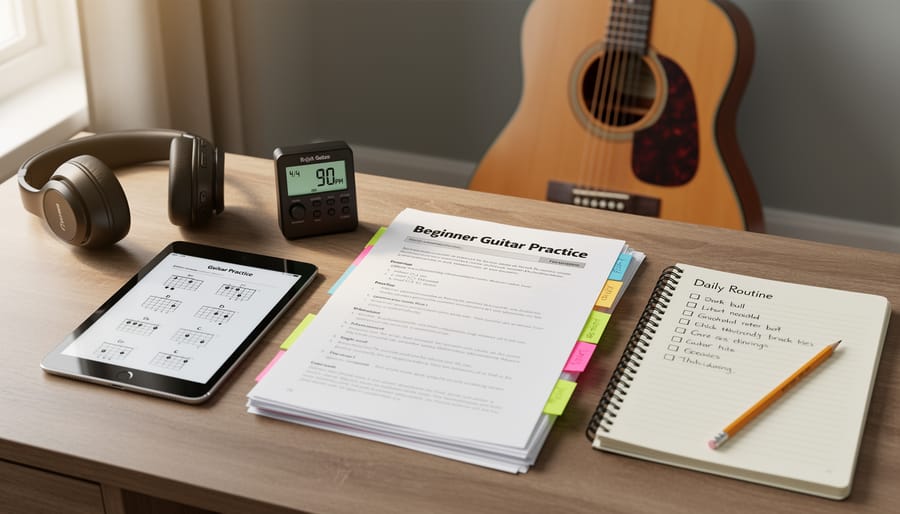
Practice logs and progress trackers help you stay accountable. I’ve watched students transform their progress simply by writing down what they practiced each day. The act of recording keeps you honest and reveals patterns in your learning.
Check whether the PDF author offers email support, forum access, or a community group. When you hit a wall, and you will, having somewhere to ask questions makes the difference between pushing through and giving up. Free PDFs rarely include this support, while paid resources often provide access to the creator or fellow learners working through the same material.
Types of Beginner Guitar Book PDFs Compared
Complete Method Books
Complete method books take you from Day One through all the fundamental skills in a carefully sequenced path. You’ll start with how to hold the guitar and tune it, then progress through basic chords, simple melodies, strumming patterns, reading notation or tablature, and eventually more complex techniques like barre chords or fingerpicking. Each chapter builds directly on the previous one.
The main advantage is that nothing gets skipped. You’re not left wondering “Wait, how do I read this?” because the book already explained it three chapters ago. The structure removes guesswork about what to practice next.
The typical experience feels like having a patient curriculum laid out. You might spend two weeks on Chapter 3’s open chords before moving to Chapter 4’s rhythm patterns. Progress is measurable and satisfying when you complete sections.
The downside? They can feel slow if you’re eager to play recognizable songs immediately. Some students find the methodical pace tedious, especially during theory-heavy sections. But if you value comprehensive understanding over quick results, method books provide the most thorough foundation.
Quick-Start Song Books
Quick-start song books take a completely different approach than traditional method books, they throw you straight into playing recognizable tunes, often within your first practice session. These PDFs skip most theory and technique-building in favor of simplified chord charts and strumming patterns for popular songs. You might learn three basic chords (G, C, D) and suddenly find yourself playing a dozen classic rock or folk songs.
This format works brilliantly if you’re motivated primarily by hearing yourself play real music. I’ve watched beginners light up when they recognize the song coming from their own guitar after just twenty minutes of practice. That emotional boost keeps them picking up the instrument daily, which matters more than perfect technique at the very start.
The trade-off? You’ll eventually hit a ceiling where you need proper fundamentals to progress. Quick-start books work best as confidence-builders or supplements alongside structured learning, not as your only resource long-term.
Reference Guides (Chords, Scales, Theory)
Reference guides, chord charts, scale diagrams, theory primers, work brilliantly as desk-side companions, but they’re terrible primary teachers. Think of them like dictionaries: invaluable when you need to look up a specific chord fingering or understand what a major scale pattern looks like, but not designed to teach you when or how to use those tools musically.
These PDFs shine when you’re already working through structured lessons and need quick visual reference. You’re learning beginner rock classics and need to see that F chord shape quickly? A reference guide delivers instantly. You want to check the fingering for a pentatonic scale between practice sessions? Perfect.
The trap is buying a comprehensive reference guide as your first resource, then wondering why you feel lost. Without context, without someone showing you how these shapes connect to actual music, you’re just staring at diagrams. Use reference PDFs to support your learning path, not substitute for it.
Hybrid Course PDFs
Hybrid course PDFs represent the newest evolution in guitar learning materials, attempting to bridge the gap between traditional static books and fully interactive online platforms. These PDFs typically include embedded links to demonstration videos, audio examples of exercises, and sometimes access to companion apps or online communities. The format combines systematic method book progression with the convenience of multimedia support, you’ll work through structured chapters while clicking links to watch a technique demonstrated or hear how an exercise should sound.
The main advantage over standalone printed materials is immediate access to demonstrations without searching YouTube or guessing at rhythm. However, they fall short of comprehensive structured modules that provide personalized practice feedback or adaptive pacing. These PDFs work best when you’re comfortable with self-directed learning but want more than silent chord diagrams. Consider whether you’ll actually use the linked resources, many students print these PDFs and never access the multimedia components, essentially paying extra for features they ignore.
Our Recommendations for Different Learning Styles
For Absolute Beginners with No Music Background
When you’ve never touched an instrument before, your PDF needs to assume absolutely nothing. Look for books that define every term before using it, what a fret is, what “strumming” means, even which fingers are which. The best beginner PDFs use conversational explanations rather than clinical descriptions, treating each concept as if you’re hearing it for the first time.
Pay attention to how quickly the material advances. A good zero-experience guide stays on each skill for multiple pages, offering several exercises before introducing something new. I’ve watched countless students abandon PDFs that jump from basic chords to complex songs in three pages. You want a resource that celebrates small wins, playing a single note cleanly, switching between two chords smoothly, rather than rushing toward full songs. Check if the PDF includes a glossary or terminology reference you can return to when confused.
For Learners Who Want to Play Songs Immediately
If your main goal is to start playing recognizable songs as quickly as possible, look for PDFs that prioritize simplified chord progressions and popular song selections over lengthy theory chapters. The best resources for immediate gratification typically introduce three to five basic chords in the first few pages, then immediately apply them to well-known songs you’ll actually enjoy playing.
However, don’t completely sacrifice fundamentals for speed. I’ve seen students burn out when they can strum along to a few songs but hit a wall because they never learned proper finger positioning or basic rhythm patterns. Choose a PDF that weaves essential techniques into song-based lessons rather than separating them entirely. The sweet spot is material that gets you playing a simple version of a favorite song within your first practice session while gradually building the skills you’ll need for more complex music later.
For Structured, Theory-Minded Students
If you’re the type who needs to understand why a chord works before you’ll practice it, look for PDFs that explain music theory progressively alongside technique. The best resources for theory-minded learners don’t just show you fingerings, they break down intervals, explain how chords are constructed, and connect scales to harmony.
I’ve worked with students who get genuinely excited when they understand that a G major chord contains the first, third, and fifth notes of the G major scale. For you, frustration comes from rote memorization without context. Choose PDFs that include theory sidebars, explanation boxes, and diagrams showing how musical concepts relate. Look for terms like “theory-integrated,” “concept-based,” or “understanding-focused” in descriptions. You’ll progress faster when every lesson satisfies your need to comprehend the underlying logic.
For Self-Directed Learners Supplementing Other Instruction
If you’re already taking lessons or working through a structured course, you want a PDF that fills gaps rather than duplicates what you’re learning. Look for materials that provide quick reference, chord charts you can print and keep near your practice space, scale diagrams organized by key, or rhythm exercises that reinforce what your instructor covered.
The best companion PDFs offer flexible practice material you can dip into as needed. When I’m teaching through my modules, students often benefit from PDFs that provide extra songs at their current level or alternative explanations of tricky concepts. You don’t need another complete method book competing for attention.
Prioritize resources with strong organization and indexing so you can jump directly to relevant sections. A good supplementary PDF should complement your primary instruction, not confuse you with conflicting approaches or terminology.
Common Mistakes to Avoid When Selecting a Guitar PDF
Choosing Based on Volume Rather Than Quality
I’ve seen too many students freeze up after downloading a massive 500-page guitar PDF, thinking bigger must be better. They flip through hundreds of chord variations, alternate tunings, and advanced techniques they won’t need for years, then never actually start playing. A focused 50-page guide that walks you through essential chords, basic strumming patterns, and a few songs you’ll actually play beats an encyclopedic tome every time.
When a beginner asks me whether a course worth it I remind them that effectiveness comes from clear progression, not page count. Three well-explained concepts you master outweigh thirty you skim past. Look for PDFs that promise to teach you specific skills rather than claiming to cover “everything about guitar.” The paralysis of too many options kills more beginner journeys than any single bad habit.
Ignoring Your Musical Interests
One of the fastest ways to kill your motivation is grabbing a beginner PDF focused on classical fingerstyle when your heart’s set on playing AC/DC riffs. I’ve watched students torture themselves through months of exercises they didn’t care about, thinking they had to “pay their dues” before playing what they actually loved. That’s nonsense. If you want to play rock, blues, or country, choose a PDF built around those styles. The chord progressions, strumming patterns, and even the finger techniques differ significantly between genres. A jazz-focused book will teach you valuable skills eventually, but if it doesn’t excite you right now, you’ll quit before you get there. Match the PDF to the music that made you pick up a guitar in the first place. You’ll practice more, progress faster, and actually enjoy the journey.
Skipping the Preview or Sample Pages
Too many guitarists buy PDFs sight unseen and discover too late that the diagrams are blurry, the font’s unreadable on their tablet, or the teaching voice grates on them page after page. Most sellers offer preview pages, use them. Check whether chord diagrams are crisp enough to see finger positions clearly, whether the explanations match how you prefer to learn, and whether the layout works on your device. I’ve watched students abandon otherwise-solid PDFs simply because the visual format didn’t click. Five minutes previewing saves weeks of frustration and wasted money.
Expecting a PDF to Replace All Instruction
A PDF is a fantastic reference and practice guide, but it can’t watch your hand position, hear your timing issues, or answer your specific questions. I’ve seen students spin their wheels for months on bad habits that a single feedback session would have corrected immediately. Think of PDFs as excellent companions to structured instruction, whether that’s periodic lessons, structured modules, or video courses with demonstrations, rather than your sole teacher. The combination of written material for reference and some form of interactive guidance creates the most effective learning environment. Self-study works beautifully when you know what good technique looks and sounds like, but getting that foundation established usually requires eyes and ears from someone experienced.
Frequently Asked Questions
Choosing a guitar book PDF often raises practical questions beyond just the content quality. Here are the answers to the most common concerns beginners have when considering PDF learning materials.
Is it better to print a guitar PDF or use it on a device?
Both work, but many students find printed PDFs easier for practice sessions since you can prop them on a music stand without screen glare or battery concerns. If you practice from a tablet, a stand or holder keeps your hands free for playing.
How long does it take to complete a typical beginner guitar book?
Most beginner PDFs contain 3-6 months of material if you practice 20-30 minutes daily, though your pace depends on prior musical experience and how thoroughly you master each concept before moving forward. Quality learning isn’t about speed.
Can I use a guitar PDF on my phone, or do I need a tablet?
While technically possible, phones are usually too small to read chord diagrams and tablature comfortably. A tablet or laptop provides a much better experience, and printing remains the most practical option for many learners.
Are free guitar PDFs as good as paid ones?
Free PDFs vary wildly in quality, from excellent community-created resources to poorly organized collections of random tips. Paid PDFs often offer better structure, professional editing, and supplementary materials, but price alone doesn’t guarantee quality.
Beyond these technical considerations, remember that the best PDF is the one you’ll actually use consistently. I’ve seen students succeed with simple photocopied handouts and struggle with expensive comprehensive courses, and vice versa. The difference always comes down to whether the material matches your learning style and whether you commit to regular practice. A modest PDF that you work through completely beats a perfect one that sits unopened on your device.
If you find a PDF overwhelming or confusing after giving it a fair chance, that’s valuable feedback. It doesn’t mean you’re a bad student; it means that particular resource isn’t the right fit. The beauty of digital materials is you can explore different approaches until you find what clicks.
Choosing the right beginner guitar book PDF isn’t about finding the perfect resource, it’s about finding the right fit for you. Throughout this guide, we’ve explored how learning progression, visual clarity, practice structure, and your personal musical interests should drive your decision. Whether you’re drawn to a complete method book, a quick-start song collection, or a reference guide that complements other instruction, the best choice aligns with how you learn and what keeps you motivated.
I’ve watched countless students start with the “wrong” material only to thrive once they switched to something matching their learning style. One of my students struggled through a dense theory-heavy PDF for months before discovering a song-based approach that had her playing confidently within weeks. The material didn’t fail her, it just wasn’t her path.
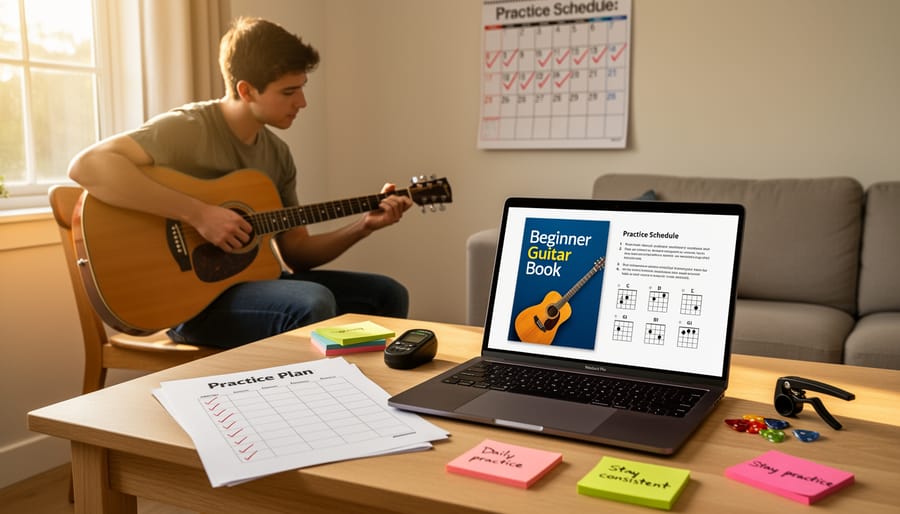
Remember that any quality learning resource, whether a well-designed PDF or a structured program like my Guitar Instruction Modules, is simply a vehicle. Your progress depends on what you do with it. Consistent practice, even just 15 minutes daily, beats sporadic marathon sessions with the fanciest materials.
You’re starting something genuinely rewarding. Those first chords will feel awkward, your fingers will protest, and some days you’ll wonder if you’re improving at all. But stick with it. Choose materials that excite you, practice regularly, and celebrate small wins. The journey from beginner to confident player isn’t always smooth, but it’s absolutely worth taking.

Your Feedback